
DMD-Dual Degree Program
DMD-Dual Degree Programs
HSDM's dual degree programs combine world-class dental education with advanced research training, preparing graduates to lead in academic dentistry, biomedical research, and clinical innovation. Students can pursue either a DMD-PhD or DMD-DMSc pathway while earning their Doctor of Dental Medicine degree.

Advance oral health through research and discovery
Combine a Harvard dental education with advanced research training and prepare for a career as a dentist-scientist, educator, clinician-researcher, or academic leader.
HSDM offers two dual degree pathways:
- DMD-PhD—for students interested in basic, translational, and interdisciplinary research
- DMD-DMSc—for students focused on translational and clinical research in oral biology and medicine
Both programs integrate dental education with rigorous research training and mentorship from leading faculty across Harvard and its affiliated institutions.
Why pursue a dual degree?
Dual degree students receive the same rigorous dental education as DMD students while developing advanced research expertise.
Graduates are prepared to:
- Lead academic and research programs
- Advance discoveries in oral and craniofacial biology
- Translate scientific findings into clinical practice
- Shape the future of dental education and patient care
- Pursue careers in academia, industry, government, and healthcare innovation
Compare your options
| DMD-PhD | DMD-MSc | |
|---|---|---|
Focus | Basic, translational, and interdisciplinary research | Translational and clinical research |
Graduate program | ||
Approximate length | 8 years | 7 years |
Ideal for | Future principal investigators, academic researchers, and scientist-clinicians | Academic clinicians, clinical investigators, and translational researchers |
Rakeem Yakubu, DMD–DMSc Candidate
Rakeem Yakubu discovered early on how research and patient care intersect to improve lives. That experience, guided by a mentor, inspired him to pursue Harvard’s dual-degree DMD–DMSc program.

Choose your path
DMD-PhD
Conduct research across Harvard's biomedical ecosystem
The DMD-PhD program is designed for highly qualified students interested in rigorous research in oral and craniofacial biology and related biomedical sciences.
Students complete their PhD through Harvard's Biological and Biomedical Sciences (BBS) Program, the same graduate umbrella program that supports the Harvard Medical School MD-PhD pathway. Students work with faculty at HSDM, Harvard Medical School, and Harvard-affiliated hospitals.
Program highlights
- Integrated DMD and PhD curriculum
- Research opportunities across Harvard and affiliated hospitals
- Faculty mentorship from leading investigators
- Preparation for careers in academic dentistry and biomedical research
Timeline: Approximately 8 years
DMD-DMSc
Advance clinical and translational research
The DMD-DMSc program prepares future academic leaders in dental medicine with advanced research training focused on oral and craniofacial biology and medicine.
The DMSc component aligns with HSDM's Oral Biology Research Program and provides intensive research training designed to bridge scientific discovery and patient care.
Program highlights
- Focus on translational and clinical research
- Mentorship from HSDM faculty researchers
- Strong foundation in oral biology
- Preparation for academic and research-focused careers
Timeline: Approximately 7 years
Program timeline
Explore how each dual degree pathway combines dental education with advanced research training, from foundational coursework through dissertation research and clinical practice.
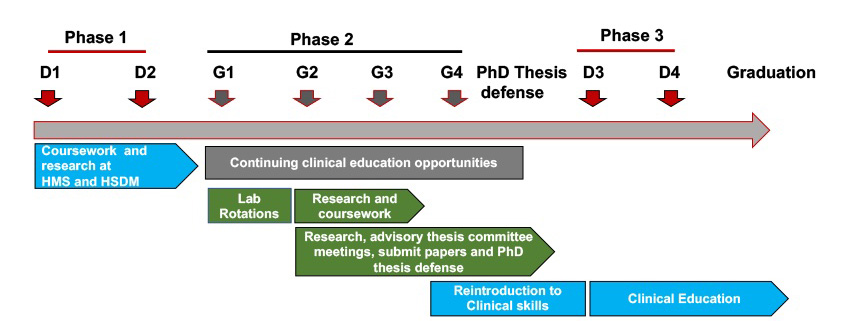
Phase 1: DMD curriculum (years 1–2)
Students complete DMD coursework and research at HMS and HSDM. Students also participate in lab rotations.
Phase 2: PhD research training (~ 4 years)
Students complete graduate coursework, continue clinical education opportunities, conduct research, meet with their advisory thesis committee, submit papers, and complete the PhD thesis defense.
Transition back to clinic
Before returning to full clinical education, students complete a reintroduction to clinical skills.
Phase 3: Clinical education (years 3–4 of the DMD program)
Students complete clinical education requirements and graduate with both degrees.
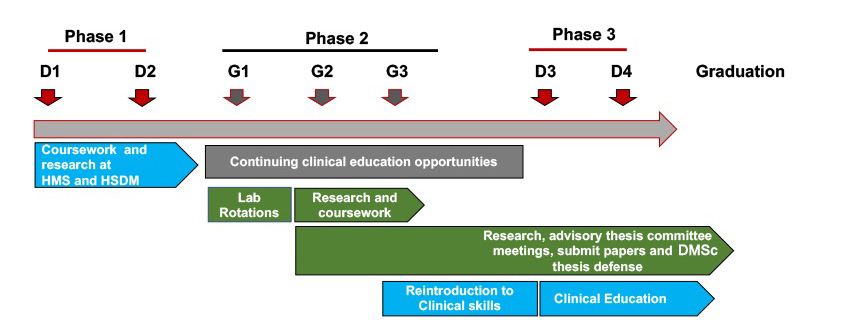
Phase 1: DMD curriculum (years 1–2)
Students complete DMD coursework and research at HMS and HSDM. Students also participate in lab rotations.
Phase 2: DMSc research training (~ 3 years)
Students complete graduate coursework, continue clinical education opportunities, conduct research, meet with their advisory thesis committee, submit papers, and complete the DMSc thesis defense.
Transition back to clinic
Before returning to full clinical education, students complete a reintroduction to clinical skills.
Phase 3: Clinical education (years 3–4 of the DMD program)
Students complete clinical education requirements and graduate with both degrees.
How to apply and funding
Applicants must first apply to the Harvard School of Dental Medicine DMD program.
To be considered for either the DMD-PhD or DMD-DMSc pathway, applicants should also email the following materials to the program director:
- Two letters of recommendation from faculty members who have supervised their research
- A statement of purpose (maximum 1,000 words)
The statement of purpose should explain the applicant's motivation for pursuing a dual degree, summarize previous research experience, describe how that experience shaped their academic interests, and outline long-term career goals.
Dual degree programs are supported through an NIH-funded T90 training grant. U.S. citizens, permanent residents, and international students may apply; however, fellowship support is available only to eligible U.S. citizens and permanent residents.
Contact us
Questions about the dual degree program?
Francesca Gori
Francesca_Gori@hsdm.harvard.edu
