

AI takes center stage at Harvard School of Dental Medicine symposium
Rapid advancements are poised to reshape dentistry from classroom to clinic
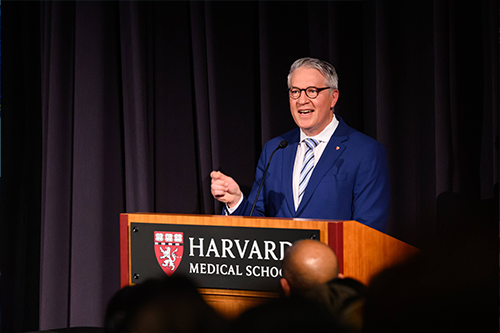
Artificial intelligence (AI) is moving quickly in dental medicine, as it has become a tool sought out by patients, clinicians, dental students, and educators alike. The topic has become so timely that Harvard School of Dental Medicine’s (HSDM) recent Global Symposium on AI, held at the Veritas Science Center, attracted over 550 in-person and virtual attendees from 53 countries around the world.
Dean William Giannobile opened the symposium by welcoming attendees to the Longwood Medical Campus. “The future of AI in healthcare is happening all around us, so this is a perfect place for us to convene,” he said. “Since our inaugural AI event in 2023, the field has advanced rapidly. In just a few years, we have seen tremendous advancements in how AI is changing the practice of dentistry.”
The two-day gathering of leading researchers, clinicians, educators, and industry innovators explored how AI technology is reshaping care, education, and the future dental workforce. In workshops, keynote presentations, poster sessions, and panels, the message was clear: AI is no longer an optional tool. It is becoming an essential partner for delivering modern dental care.
From tool to teammate
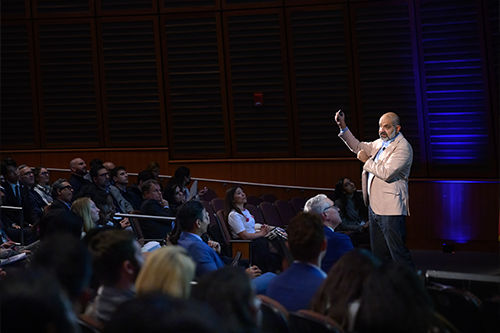
Karim Lakhani, a Harvard Business School professor known for his pioneering work in digital transformation, gave a keynote presentation on Competing in the Age of AI in a World of Abundant Expertise. He charted the exponential trajectory of AI’s capabilities and predicted that AI will lead to a fundamental shift in how professionals work.
“AI is transforming from a tool to a teammate,” Lakhani said. He noted studies that tracked work done by individuals on their own, teams without AI, and teams assisted by AI. “Teams with AI consistently outperform individuals—and even teams without AI. AI provides the missing expertise.”
But he cautioned that this rise in AI’s capabilities comes with risk.
“AI is a jagged technology,” Lakhani warned. “It can dramatically improve outcomes, but also drastically reduce performance. The edges are sharp. Your judgment is aided, but not replaced, by AI.”
He urged clinicians and educators to prepare for a steep learning curve—what he called the “AI J-curve.” Early adoption can decrease performance before improvements emerge. “You have to practice,” he said. “Every person becomes a team empowered by AI agents.”
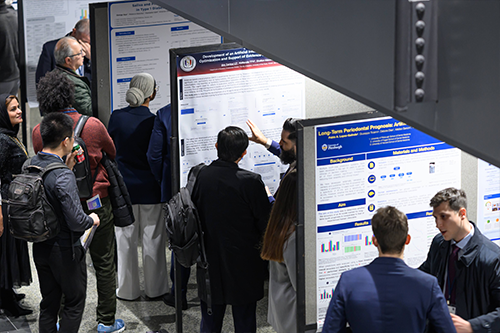
After Lakhani’s presentation, attendees had a chance to see up-and-coming AI research and innovations in nearly 90 scientific posters on display throughout the venue. The posters highlighted the work of presenters from across academia and industry, including several posters from the more than 150 dental students in attendance.
Bringing dentistry to the table
Jim Weinstein, a spine surgeon and pain researcher, who is senior vice president of Microsoft Healthcare, opened the second day of the symposium with a keynote on Ecosystem Transformation. Through his lens of leading strategy, innovation, and health equity at Microsoft, Weinstein referred to AI as “the fourth industrial revolution.” He emphasized its potential to integrate dentistry more fully into the broader healthcare system.
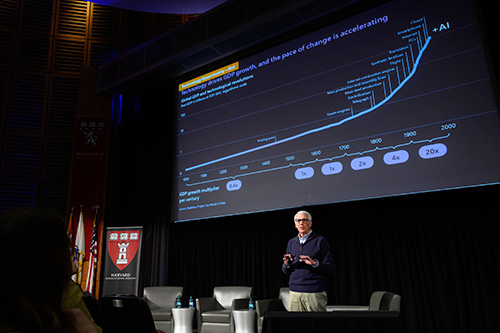
“We need dentistry at the table,” he said. “AI can support tele-dental care in rural communities, help reduce chronic disease, and empower patients. But it can only represent people if their data is represented equally.”
Weinstein described a future in which AI enables “whole-patient” insights across medical and dental domains—integrating biology, population-level data, and clinical histories to guide decision-making. That future, he argued, demands dentistry’s full participation.
He predicted that AI agents will soon become woven into everyday practice. “I envision every practitioner using AI as your own agent,” he said.
At the same time, Weinstein cautioned that the technology must remain human led, “People should drive the technology, not the other way around. We can’t have trust if we’re not transparent.”
From precision care to individualized dental training
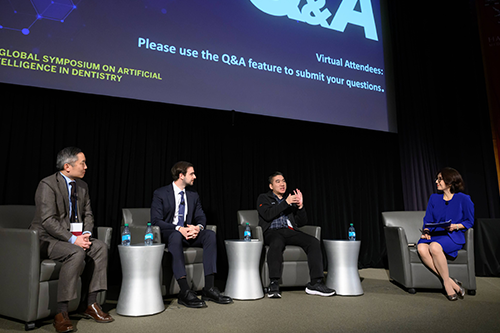
As AI is transforming clinical care, it is also rewriting the blueprint for how dentists are trained.
Bernard Chang, dean for Medical Education at Harvard Medical School (HMS), spoke about the potential of AI to transform medical and dental education in a panel moderated by Sang Park, associate dean for Dental Education at HSDM. Chang shared an example of how AI can help assist students at different learning levels by keeping pace with their individual learning style and needs.
“We’re developing ‘tutor bots’ that students can personalize,” he explained. “This is precision education. AI can support each learner in a way no human tutor could.”
Panelist Balazs Feher, assistant professor at HSDM, emphasized that AI is already embedded in students’ lives—even if curricula sometimes lag behind. “Our students are using the technology we’re not yet teaching them to use,” he said.
Feher discussed how HSDM is using artificial intelligence in diagnostic, prognostic, and generative modeling in dental medicine to develop tools for students in clinical training.
Faculty are benefiting from AI in the classroom too. A new AI-powered assessment tool can summarize class-wide performance, giving instructors real-time insight into students’ needs. Chang noted this kind of benefit has won over faculty who were initially reluctant to embrace AI. “It didn’t replace something they were doing—it just gave them more capabilities,” he said.
Co-intelligence, not competition
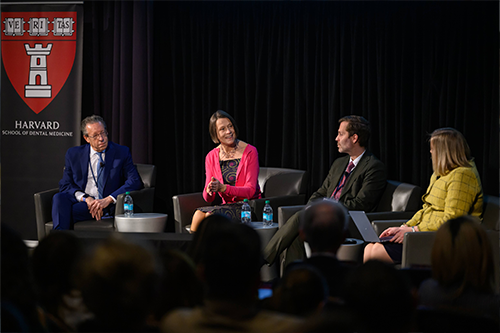
It’s not just clinicians who are interested in AI. Patients are increasingly turning to AI even before they visit their dentist. One in six adults (17%) say they use AI chatbots at least once a month to find health information and advice, according to a KFF tracking poll.
“Every clinician has to feel like their job needs to change today. Our patients are going to demand it,” said Barry Stein, chief clinical innovation officer and medical informatics officer for Hartford HealthCare. He described how his healthcare system is using AI to tackle patient access, portability, equity, and safety.
Panelist Florian Hillian, founder of VideaHealth, highlighted how multimodal AI can synthesize complex imaging and patient data far faster than humans.
“It’s like working with a colleague who gives you a second opinion,” Hillian said. “Look at AI as ‘co-intelligence.’”
Still, he stressed that AI will never replace clinicians. “It’s never AI versus the dentist. It’s dentists with AI.”
The panelists agreed that new workforce roles will emerge alongside AI—such as AI reviewers, annotators, and data-quality specialists, while traditional front-office and administrative roles may benefit from automation—freeing up time for other tasks.
A race between innovation and governance
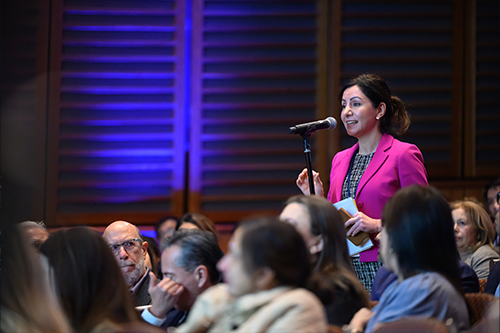
The rapid pace of AI deployment has raised considerations around ethics, privacy, and regulation. A panel on AI bioethics looked at legal implications, ethical considerations, and safeguards for both patients and clinicians.
“How do we think about knowledge when the knowledge talks back,” posed moderator Klara Jelinkova, Harvard University vice president and chief information officer.
Arjun (Raj) Manrai, assistant professor in Biomedical Informatics at HMS, warned that the same question asked of an AI chatbot by a patient, parent, doctor, or insurer can produce radically different answers. “We need the same evidentiary standards we require for drugs and devices, including randomized controlled trials,” he said. “We’re not there yet.”
Panelists stressed that today’s AI tools often fall outside medical-device regulations, leaving clinicians vulnerable. Without standardized safety models, liability becomes murky.
On privacy concerns, speakers advocated for adaptive governance—tiered consent systems that allow patients to understand and control how their data is used. “Patients need to know they can turn sharing on or off,” Manrai noted.
Despite these challenges, optimism prevailed. AI, they argued, could democratize access to care in underserved regions—so long as standards remain consistent worldwide.
As the symposium concluded, Dean Giannobile echoed the hope that AI’s potential can be harnessed for the greater good.
“As we leave today, may we all take with us the hope for a future where AI can help improve oral health outcomes for our patients, open doors to care for those without access, and lead us to the discovery of new cures for diseases.”